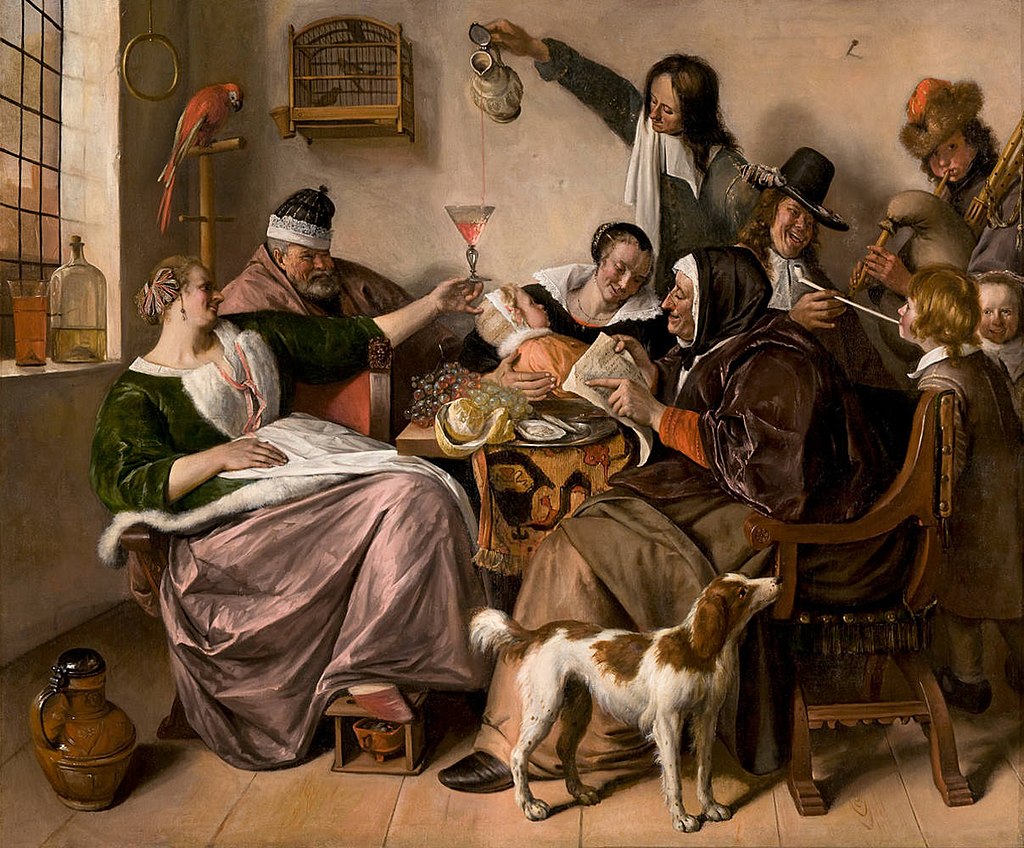
Banquets, as formal invitations to intemperance in both kinds of enjoyment, have in themselves, aside from physical enjoyment, something that tends towards a moral end, namely, to get many people together and for a long time to communicate with each other; but, nonetheless, since a certain quantity (when, as Chesterfield says, it exceeds the number of the Muses) only allows for a limited communication (with our neighbours at the table), thus contradicting such end, it still induces us to immorality, that is, to intemperance, a transgression of the duty towards oneself; even if we disregard the physical harms of excess, which doctors may be able to eradicate. How far does the moral right to listen to these invitations to intemperance reach?
Metaphysics of morals, 6: 428
1
Kantian ethics is sometimes mocked as a morality for angels, a principle for action so pure and so high that it completely disregards the human predicament and our limitations. Sure, Kant had a lot to say about anthropology, and about applying ethics to our actual conditions, but how much of this is paying lip service to common sense? Can he actually save the system, or does he merely say that he can do it?
It doesn’t take too long to see that these objections, whilst perhaps well grounded in some regards – say, about motivation -, miss the mark when it comes to the content of our ethical duties under a Kantian system. If we take the standpoint of a purely rational being, unfettered by the chains of corporality, though we can still elaborate some duties that exist solely at the intellectual level, we lose the actual meat of ethical demands. Thou shalt not kill? Angels don’t care about this. Thou shalt save a kid drowning in a pond, or starving? Again, not their problem! It is the fact that we are frail and needy things that results in a whole litany of do’s and do-not-do’s.
Our dignity and moral standing, under the Kantian view of things, comes from our rational nature, which we would indeed share with immortal beings engaged in pure contemplation. But we have specific means and specific conditions by which we actualize rational agency. If you kill me, my biological and animal me, you deprive me absolutely of “external freedom”, because I cease to exist, and thus there are no more rational goings-on from my part. Inasmuch as there can be rational beings who can only exist by virtue of maintaining certain physical conditions – and we don’t need to imagine that; it is the other possibility that might be fanciful -, then protecting rational nature will take the form of protecting the physical beings who are endowed with rational nature. Harming, maiming, letting die, these will all be wrongs to the dignity of beings with moral standing.
This same train of thought is what gives rise to the controversial category of duties towards oneself, but how wouldn’t it? If the dignity of rational nature is observed by cherishing its mortal vessels, having oneself as an exception would be a deeply un-Kantian move. If it applies with full generality that one ought not harm others, the same token should be valid to not harm oneself. If this sounds ridiculous, my modus ponens is your modus tollens, but the implications from the universalization of maxims seem clear enough.
2
I mentioned by passing the idea that some duties may still hold even for purely intellectual beings. Respecting others, not breaking promises, and so on, might be conceivable as duties even for such higher beings. Nonetheless, that a duty is purely intellectual doesn’t mean that we can engage in it in a purely intellectual fashion. We are still rational animals when we make promises, or when we take upon ourselves the goals of others whom we befriend. Our promises are about corporeal matters, they are expressed through physical media, in our voice, in our written contracts, what have you.
And with this come limitations, which starts making things tricky. In theory, if universality is the criterion for endorsing maxims of action, the worrisome class of “partial duties” should be rejected from the start. We don’t owe more to our friends or our families than anyone else, they have the exact same dignity, exact same entitlements as anyone else: humani nihil a me alienum puto, right? Of course, however, we simply cannot befriend everyone in the world. If we have a duty of friendship and amity, we cannot spread ourselves too thinly. It goes even beyond this, though. Conceivably, it is a general duty of love to others, and not of friendship in particular, that the categorical imperative commands. It could be that, being the sort of beings we are, we cannot but form friendships in order to fulfill a this more general duty; and it might be that friendships, as forms of love towards each other specific to the rational animals we are have to be partial. And, the killing stroke, it might be that these forms of relation towards each other that we cannot avoid in fulfillment of our duties beget new, one-sided and partial duties towards some people and not others. Much as how I get bound when I make a promise to you, I get bound when I enter into a friendship with you. The constraints of our nature over the realization of general duties complicates the ethical picture and generates demands that, when seen from afar, seem awfully anti-universal and problematic.
It only gets worse. Kant seems to be profoundly uncomfortable by anything related to sexual relations, but he faces the obvious problem that, if we care about the ultimate persistence of rational nature in the planet, they are not going anywhere. The whole institution of marriage is meant to dissolve the ethical problems which the “self-transformation” into a mere thing Kant takes to make up intimate relations entails. Institutional arrangements, in the broadest sense of the word, direct and make acceptable those specific breaches of ideal conditions of morality which are mandated by our continued commitment to furthering the cause of rational nature. How far do these excuses reach, though? We appear to tread on thin ice if problems with implementing duties in our corporeal context translate into near collisions with other demands of the moral law.
3
The argument against self-intoxication by alcohol or other drugs would appear simple enough. We can place them under the umbrella of any other harms towards oneself. To sacrifice our overall health over short-term enjoyment isn’t precisely indicative of respect towards the preservation of rational nature. However, this won’t hold water. Literally everything that we do as the finite, soft, etc., beings we are brings a risk with it. Not only does every pursuit of happiness – which, in a very broad sense, we may have to take as a duty, since a miserable life undermines the psychological possibility of promoting the good around us! – carry with it the shadow of possible accident, but so do all of our other duties. If respect towards rational nature means absolute prudence against potential downfalls, we can never save children from ponds, or marry each other, or see friends; the one duty would be to protect ourselves from the elements – one ethical system, that.
If, on the other hand, it is a matter of good judgment to ascertain how much risk is too much risk, and what deserves it, then the idea that we can prescribe a priori a duty against intoxication is laughable. The one duty would be a general one to care for one’s health, but there would be latitude in seeing what exactly is allowed within that goal. Is alcohol fine? Tobacco? Is wine fine? Whisky? A glass? Two? Thus why Kant decides not to go that way. The problem with drugs, Kant says, isn’t (just) that it can lead to health issues, let’s forget that for a moment. Rather, the concern is that the direct – and perhaps desired – effect of them is to hamper rational capacities. It isn’t that you are more likely to die if you drink, it is that, as an immediate result of drinking you cease temporally to function as a rational being.
The casuistic is trickier than it should be because of what we’ve gone through up until this moment. All this build-up is just for one point – maybe two. Our duties of sociability, or love towards others, or what have you, take certain institutionalized forms that may be unavoidable insofar as we cannot just live by universal love towards all. It isn’t all that clear to me that these institutional forms don’t include taking part in certain forms of temporary suspension of rational capabilities. Much like how our prolonged existence on Earth – as a species but, I may add, perhaps even as individuals – requires us to “give ourselves as things” to others, our fully forming loving bonds with others and entrusting them with our deepest secrets and most cherished goals might come through moments of voluntary irrationality. Not necessarily through wine, mind you, but maybe through wine among others. And much like how we need rules around what is acceptable in our intimate life, to “institutionalize” in the broadest and softest of senses our giving ourselves to others – since there is always a risk in being treated as a mere thing, and some of the worst derelictions of dignity occur in those contexts -, we do as much with the ritualized forms by which we take vacations from rationality. We may need them, for the sake of our dignity and our duties.
One final thought. It is quite apparent that our displays of love and friendship involve moments of openness that might be made possible by temporary waiving our actual rationality. But there is no reason to believe that this is the only one of our duties for which it is true. Isn’t it conceivable – and more than conceivable, a common trope – that some heights of mental prowess and development of our collective intellectual endeavours may only happen as a result of “rational breaks”? Of, quite bluntly, intoxication? This isn’t just a crudely utilitarian weighing of pros and cons to maximize rational output, it rather might be that our human condition, as it stands now, is such that a completely consistent maintenance of active rationality is constitutively contrary to the highest expressions of the very capacities that are meant to be promoted and preserved. If so, we reach a baffling conclusion: a feisty Kantian might be warranted in following a certain Frenchman and, from a motive of duty, proclaim: enivrez-vous.

 Álvaro Rodríguez-González Barredo
Leave a comment