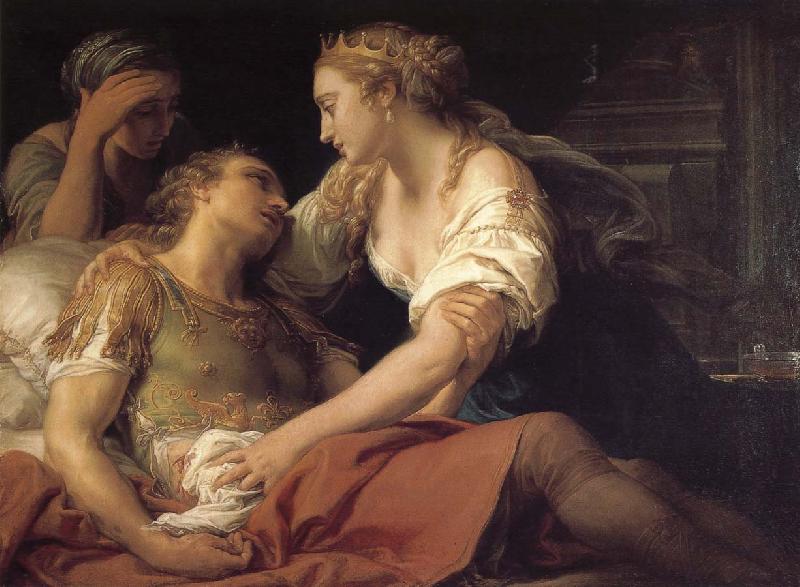
“For self-consciousness, there is another self-consciousness; self-consciousness is outside of itself. This has a twofold meaning. First, it has lost itself, for it is to be found as an other essence. Second, it has thereby sublated that other, for it also does not see the other as the essence but rather sees itself in the other.” (PdG, §179)
1
This is not Hegelian exegesis. To take a singular moment in the development of consciousness out of the whole and try to derive a substantive point out of it might be close to a capital sin as far as Hegel’s philosophy goes. Breaking the constraints of diligent interpretation, however, has historically been a reliable way of getting insights off the ground. Many people have found something like this in the first section of the fourth chapter of the Phenomenology. I join them in using a Hegelian excuse to write some thoughts; in this case, about loss.
2
A particular philosophical tradition has faced perennial criticisms with regards to the flimsy and ethereal being that they have taken the self to be. A simple thinking being, a mere vanishing point onto which the angles of existence converge, little more than a nothingness. There is much to be mocked about this picture, if we think that this purity is a potential source of eternal and stable truths about reality. To think, however, that it is a fundamentally wrong picture in some foundational sense, that it is a non-starter, seems to me a mistake. As if the contents of our self were pre-given and ready to hand, as if we could take for granted that each of us has substantiality without any struggle. The emptiness of the self is not just (although it is that as well) a piece of ancient wisdom, it is a warning.
Heideggerian anxiety has always struck me as an especially sharp way of cashing out this worry. It does not take that much for us to lose confidence in the stability of the “things out there”, of our sources of value and meaning. True as it is that we cannot even make sense of a properly solipsistic stance, if we understand it as the starting point of thought, the possibility of solipsism always looms behind us. Not that Heidegger would have liked to put it this way, nor would I like to be wedded to his system. Something of this sort, though, seems to be what happens when the network of meaning that we take for granted suddenly appears to lose its grounding. We find ourselves forcibly dragged into the chamber of self-identical certainty, of our empty cogito.
It would be fairly disappointing (liberating or not) to go on and pursue the Delphic maxim, γνῶθι σεαυτόν, and find out that the only thing there was to know of oneself was an empty silence, a metaphysically dubious receptacle of impressions. I do not think that this is an apt answer, at any rate. It is not true either that the only options that press us and persuade us are apt.
It would be, more than disappointing, deeply worrying, to find out that we can make it the case that the self reduces to a silence. And yet. If the solipsistic ego is not our natural resting point, it is among the things we can build. Once the precarious certainty of the substantial self is made to shake, the path in that direction is broad and downhill.
3
At the start of chapter IV of the Phenomenology, the consciousness has just encountered a world that is now, in one sense, for her. But it isn’t home yet. As self-consciousness, it takes itself to be the sole abode of truth, and its outlook towards the world is one of mere desire and consumption. There is a childlike version of this outlook into the world, where things are fluid, simply set out there for our enjoyment. That’s just a healthy stage of development before running head-first into the more stubborn external realities. It has a more jaded counterpart, however: that of the born-again solipsist, for whom the only relation with things available is consuming them, making them a part of the void of our self-referential being.
In either case, it is clear that there is no finding a solid grasp in this way of interfacing with the world. “Desire and the certainty of itself achieved in its satisfaction are conditioned by the object, for the certainty is through the sublating of this other”, says Hegel. The consumer self is worse than its isolated rumination, it becomes little less than its very objects of desire. Kind of relatable?
The moment of genius arrives here. Hegel seems to be spot on about the kind of encounter that actually gets one out of this comfortable self-centredness. There is one “thing” among desired things that cannot simply be consumed, and that brings us so much more than chomping through mere pleasurable stuff. Finding another person.
4
In the encounter with another person, using the same vocabulary of desire that characterised the consuming solipsist is downright inappropriate. What we encounter in the other is so much more than an object of pleasure. We finally find ourselves in a much more real way than our inwards reflection could have allowed.
What is in us? We have desires, we have worries, we have aspirations and dreams and projects. That is a lot. But all of them are hanging by the thread of the negative moment that lives inside us with so much more certainty. Because all of those can be given up on, they can be overcome, we can become radically different people the moment they stop making sense to us. In the gaze of a fellow, however, we are there as something that is actually real, and which cannot be so easily erased by the uncertainty of our introspection. The person that loves you, that has grown fond of your smile, of your quirks, of your excitement at things little or large, gives you even more than love, they gift you a You that you couldn’t have conjured on your own. And by loving them in return you not only have the happiness that comes from knowing that there is someone through whose particularities you can also live and enjoy, but you give them another You for them. The moment of love goes so far beyond mere desire in this precise sense; it is a moment where the both manage to find themselves. In loving relations there is not just a whole that goes beyond the parts, but parts that only exist thanks to the whole.
The resolution of this mutual encounter according to Hegel is extremely well-known, and it may seem to paint an impossibly grim picture for it to even enter in the same conversation as love. After having found the Other, consciousness sees itself battling a duel to the death, with only two possible outcomes, neither of which can leave us satisfied. One is death, after which there no longer is someone looking at us. The other is servitude. What has happened?
5
Let’s leave aside the reasons behind Hegel’s development of things here, and stay instead within the scope of love. Two considerations are obviously missing out of my earlier description of an encounter with the other.
One is neatly positive. We don’t just encounter an other, but many others. Our love towards people takes many shapes, we find ourselves in ever so different ways in the eyes of each one of our companions, and we give them in return a version of themselves unique to our relation.
The other one is, naturally, that the inward-looking self does not and ought not to disappear in relating to others. As much as I’ve emphasised the dangers of solipsistic retreat, that we can take a step back and cut ourselves from any one thing we chose to identify with is the basis of our freedom and autonomy (Wo aber Gefahr ist…). If we give up on that, the self that we find in the other becomes an imposition, it goes too far in the direction of looking outwards.
When we are in love, two real possibilities are always present, two ways for us to eventually stop finding ourselves in the eyes of the other. One is the more sobering version of the duel to the death; our loved ones can simply cease to be, duel or not, and their gaze no longer be out there for us to see. The other is an implication of the freedom that ought to give life to our relations. The other can turn their back. Look towards others, maybe. Towards themselves. Looking at each other in the eye can be put to an end by either person. A desperate measure when confronted with this is to not allow it and struggle; the result ends up being servitude on either side. It is a desperate measure because it cannot solve the problem, the free choice to turn one’s back cannot be reversed by force. If we resist as slaves, we are now lost in the whim of our master; if we do so as masters, the face that looks at us is that of a hostage, a medium, not an other that can give us the us we are.
6
The Hegelian bet at this point is to remain confident that there lies ahead a mode of living with others that is not prone to this essential instability. I am not so sure about that. It takes a special type of philosophical temperament to believe that human tragedy hints at a different venture point from which it might dissolve. I am more suspicious. We lose ourselves amidst others. We find ourselves in others that we can lose. When we lose them, we lose ourselves once more. At least, the us that used to live in their eyes.

 Álvaro Rodríguez-González Barredo
Leave a comment